
Just Volleyball Game Modes: 1v1 to 6v6 Ranked
Every just volleyball team size explained, from the 1v1 duel to the full 6v6 court, with the best mode for beginners and the settings that change a lobby.
Just volleyball ships with six team sizes: 1v1, 2v2, 3v3, 4v4, 5v5, and 6v6. They use the same court, the same ball, and the same controls, but they are not the same game. A 1v1 match is a duel; a 6v6 match is a coverage puzzle. Choosing the right size is the fastest way to enjoy the game and the fastest way to improve.
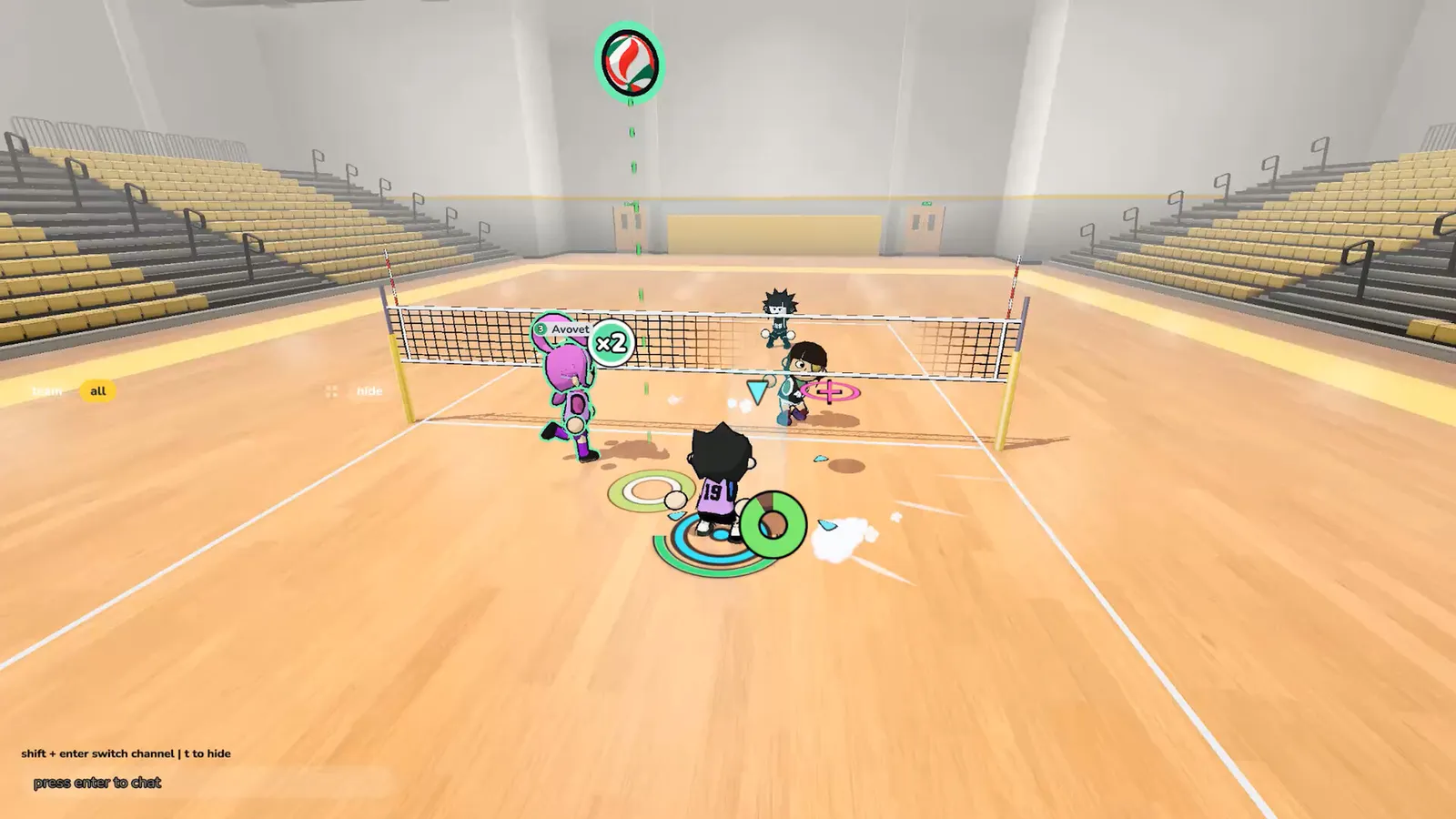
Best for learning: 2v2. Best for the full experience: 6v6. Best for mechanics: 1v1. Best for a party: 4v4. Everything else is a variation on those four.
1v1: the duel
One player per side, half the court to cover, and no teammate to blame. The serve is a weapon, the pass is a survival test, and the attack is usually a single swing.
What it teaches: court coverage, serve placement, and the value of a high-percentage shot. You cannot hide in a crowd.
Why it is hard: every ball is yours. A bad first touch is immediately a point against you. New players often lose 1v1 matches without ever running a full rally.
Best use: a warm-up or a mechanics drill. Play it when you want to isolate a weakness, not when you want a relaxing match.
2v2: the classroom
Two players per side is the sweet spot. You have a partner to pass to, but the court is small enough that you still touch the ball on most rallies. The pass-set-hit pattern appears naturally, and the coverage problem is simple enough to solve with one callout.
What it teaches: passing to a person, setting to a spot, and covering your partner. It is the mode that turns a new player into a functional one.
Why it is the best beginner mode: the feedback loop is short. If you make a mistake, you touch the ball again in a few seconds. In 6v6, you might wait a full rally to get another rep.
Best use: your first twenty matches. If you only play one mode before launch, play this one.
3v3: the first real team
Three players per side is where a setter emerges. One player takes the second touch, one attacks, one covers. The role is not enforced by the game, but the geometry pushes you toward it.
What it teaches: off-ball movement. With three players, someone is always away from the ball, and that person's position decides whether the next contact is easy or impossible.
Why it is awkward: if all three players chase the ball, the court is empty behind them. 3v3 punishes ball-chasing more than 2v2 because there is more space to leave open.
Best use: a transition mode. Play it when 2v2 feels too small but 6v6 still feels like chaos.
4v4: the party mode
Four per side is the size the demo's local setup screen hinted at, and it is the most forgiving social mode. There are enough players to cover the court, enough touches to run a real play, and enough chaos to produce comedy.
What it teaches: defensive shell. Two blockers and two defenders is a simple, effective shape, and 4v4 gives you just enough bodies to try it.
Why it works for a group: one weak player does not sink the team. The court is small enough that a beginner can contribute by standing in the right place and passing high.
Best use: a lobby with mixed skill levels, a couch session, or a LAN night.
5v5: the crowded court
Five per side adds a second attacker and a dedicated setter, but it also adds traffic. Two players going for the same ball is more common than in 4v4, and the block can become a wall of bodies rather than a coordinated seal.
What it teaches: communication. At five, you cannot rely on geometry alone. Someone has to call the ball and someone has to call the block.
Why it is the awkward middle: it has most of 6v6's complexity without the full court's spacing. Some lobbies love it; many skip straight to 6v6.
Best use: a full lobby that wants a slightly faster, more chaotic version of 6v6.
6v6: the full game
Six per side is the classic volleyball shape: three front-row players, three back-row players, a setter, and a block that can actually seal the net. It is the mode the game's systems were designed for, and it is the most rewarding once you can pass.
What it teaches: reading, rotation, and role discipline. The ball is faster, the court is fuller, and the player who is out of position is exposed immediately.
Why it is hard for beginners: you can go a whole rally without touching the ball, and when it finally comes to you, the pace is higher than in 2v2. That is why the beginner guide recommends starting small.
Best use: the main event. Once you can serve in, pass to a teammate, and stand behind the block, 6v6 is the best version of the game.
The modes side by side
| Mode | Difficulty | Touches per player | Best for | Main lesson |
|---|---|---|---|---|
| 1v1 | Very high | Constant | Mechanics drills | Coverage and shot choice |
| 2v2 | Low | High | Learning | Pass-set-hit |
| 3v3 | Medium | Medium | Transition | Off-ball movement |
| 4v4 | Low-medium | Medium | Parties and mixed lobbies | Defensive shape |
| 5v5 | Medium-high | Medium | Full lobbies | Communication |
| 6v6 | High | Lower | The full experience | Reading and roles |
Custom lobbies and modifiers
The developer's quoted feature list mentions custom lobby modifiers, including "sweat" and toggles for replays. Those are the kind of options that let a group tune a lobby without changing the game:
- Sweat likely tightens the rules or the difficulty, which is useful for a competitive group.
- Replay toggles control whether highlights are recorded, which matters on lower-end machines.
- Bots fill empty slots and let a small group play a full-size mode.
The exact modifier list will be visible in the lobby menu at launch. Treat the names above as the developer's description, not as a complete menu.
LAN, split-screen, and online
All three are supported, and they serve different groups:
- Online is the default. A server browser lets you pick a lobby by ping and mode.
- LAN is for a room full of PCs. It removes internet latency and makes a local tournament practical.
- Split-screen is for one screen and multiple controllers or keyboard players. The demo's setup showed four slots, so plan for four until the store page confirms more.
The multiplayer guide explains how to host and join, and the friends guide is a step-by-step for setting up a session.
Which mode should you play first?
If you are new: 2v2. If you have a group of four: 4v4. If you want the game at its best and you can pass: 6v6. If you want to improve alone: 1v1 against a bot, but only as a drill.
Do not judge the game by a single 6v6 match in your first hour. The full court is the most complex version of the game, and complexity is not the same as quality. The tips page covers the habits that make the jump from 2v2 to 6v6 manageable.
FAQ
What is the best mode in just volleyball?
6v6 is the fullest version of the game, but 2v2 is the best mode for learning. The right answer depends on whether you want the best experience or the best classroom.
Can you play 1v1 against bots?
Yes. Bots are supported in offline play and can fill a lobby at any team size.
Does the game have ranked mode?
No ranked mode has been announced. The server browser and custom lobbies are the confirmed online structure.
Is 6v6 too chaotic for beginners?
It can be. Start with 2v2 or 3v3 until serving and passing are automatic, then move up.
Further reading
Official source: just volleyball on Steam for the 1v1-6v6 mode list and LAN/split-screen categories.
More just volleyball Guides
The official just volleyball Discord invite, what the temkosoft server is for, how to find matches, report bugs, and avoid fake keys and scam links.
Fast answers on the just volleyball release date, price, demo, crossplay, gamepad support, LAN, split-screen, system requirements, and launch status.
A plain-language just volleyball tutorial: the rally flow, the three-touch pattern, each position, and the fastest way to survive your first online match.
A step-by-step guide to playing just volleyball with friends online, on LAN, in split-screen, or via Steam Remote Play, plus fixes for common lobby problems.
How just volleyball multiplayer works across online play, LAN, split-screen, and co-op, including the server browser, lobby sizes, ping, and moderation.
The free public playtest opened on September 23, 2026 on a separate Steam app. Here is how it differed from the demo and whether it is still running.
The developer quoted a $7.99 base price for just volleyball with a 38% launch discount. Here is what is confirmed, what is not, and how regional pricing works.
The defensive half of just volleyball: how to receive a serve, set a hittable ball, position behind the block, and cover the court without wasting stamina.