
Just Volleyball How to Play in 10 Minutes
A plain-language just volleyball tutorial: the rally flow, the three-touch pattern, each position, and the fastest way to survive your first online match.
Just volleyball looks like a party game and plays like a fighting game. The ball is fast, the court is small, and every contact is manual. The good news is that the rally has a rhythm, and once you recognise it you can stop chasing the ball and start building a point.
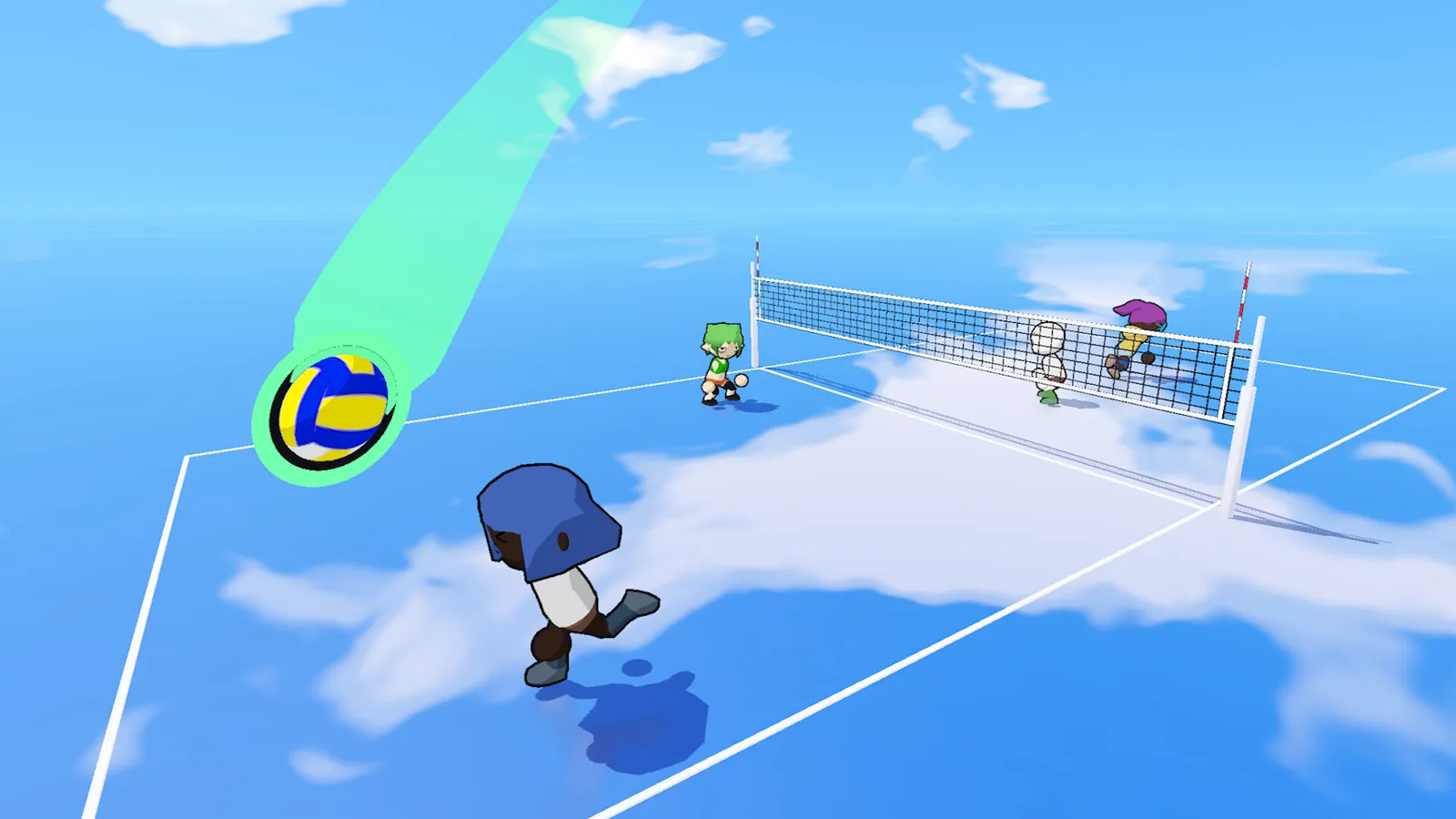
Serve the ball in. Pass it to a teammate. Set it near the net. Hit it into space. If the ball comes back, do it again. Everything else is refinement.
The rally, step by step
A rally has four beats. They do not always happen in a clean sequence, but the shape is consistent:
- Serve. One player puts the ball in play from behind the end line. The serve is the only contact you fully control before the opponent touches the ball.
- Receive. The defending team passes the serve. The first touch should send the ball toward the setter, not straight over the net.
- Set. A teammate lifts the ball to an attacker near the net. The set decides where the attack happens.
- Attack. The attacker hits the ball into the opponent's court. The opponent may block it, dig it, or let it land.
After the attack, the cycle repeats with the defending team receiving. A rally can last two contacts or twenty. The team that keeps the ball off the floor wins the point.
The three-touch pattern
Volleyball gives each team up to three contacts before the ball must cross the net. Just volleyball uses that structure as the default rhythm:
- Touch one: receive or dig. Goal: control, not glory.
- Touch two: set. Goal: put the ball in a spot where a hitter can attack.
- Touch three: attack. Goal: score, or force a bad reply.
A block is a special case. In standard volleyball, a block does not count as one of the three team touches, which is why a blocked ball can still be played three times. If a build handles that differently, the on-screen indicators and the tutorial will tell you; the safe habit is to treat the block as a bonus contact rather than as your first touch.
The pattern is not a rule you must obey literally. A one-touch return is legal if you can make it. But the three-touch pattern is the highest-percentage way to play because it gives the attacker the best angle and the defence the most time to organise.
What each role does
Just volleyball does not lock you into a class. In 6v6, players tend to settle into functional roles based on where they stand and what they are good at.
| Role | Job | Common mistake |
|---|---|---|
| Server | Put the ball in play, target a weak passer | Trying to ace every serve and missing long |
| Passer | Receive the serve and keep it off the floor | Aiming at the net instead of the setter |
| Setter | Turn a pass into a hittable ball | Setting too close to the net or too far from the hitter |
| Hitter | Attack the third touch | Hitting into the block instead of the gap |
| Blocker | Seal the net and funnel the attack | Jumping late or drifting into a teammate |
| Cover | Pick up blocked balls and tips | Standing flat-footed behind the block |
In 1v1 and 2v2, you are all of these roles at once. That is why small modes are the best classroom: every contact is yours, so you learn the whole sequence instead of one slice of it.
Serving: the first skill to learn
A serve has two inputs: the toss and the contact. New players rush both. Slow down. Toss, watch the ball, then contact it with the cursor aimed at a target. A serve that lands in is better than a serve that almost aces but misses.
Aim for three zones:
- Deep corner. Pushes the receiver back and stretches the pass.
- Short middle. Forces a receiver to step forward and pass upward.
- Seam between two players. Creates confusion about who takes the ball.
The float serve is the staple: little spin, late movement, and a flat trajectory. The serve guide covers the timing in detail.
Receiving: aim at your teammate
The receive is where beginners lose matches. The instinct is to hit the ball back over the net. Resist it. Put the cursor on your setter or your teammate and let the pass travel. A high, slow pass to the middle of your court is a good pass; a fast ball that flies over the net is a gift to the opponent.
If the serve is too strong to control, a dig or a dive keeps the rally alive. The goal is not a perfect pass; it is a playable ball.
Setting: lead the hitter
The set is a pass with a purpose. Aim at the space in front of the attacker, not at their body. A set that arrives early lets the hitter approach; a set that arrives late forces a desperation swing. Hold E to charge the set if you need more distance, and release when the arc looks right.
In 3v3 and up, the setter should call the play. A simple "middle" or "outside" is enough. The quick chat keys (1-4) exist for players who do not use voice.
Attacking: hit the gap, not the player
A spike is not a power contest. The best attack is the one that lands where nobody is standing. Look at the block before you jump: if two blockers are packed on the line, hit cross-court; if they are spread, hit the seam. If the block is late, hit it high off the hands and out of bounds.
The spike guide covers approach timing, contact point, and shot selection. The short version: jump early enough to meet the ball at the top of your reach, and aim at the floor, not at the back wall.
Defence: block, then cover
A block without cover is a highlight that loses the rally. The blocker seals one angle; the defenders behind pick up the deflection. In 4v4 and up, assign one player to cover the line and one to cover the cross. In 1v1 and 2v2, the block is optional; a good defender in the right spot is often worth more than a gamble at the net.
Choosing your first mode
Start with 2v2. It is small enough that you touch the ball often, but large enough that you learn to pass and cover with another person. 1v1 is a great mechanics drill but a brutal first experience; 6v6 is the full game but too chaotic until you can pass. The game modes guide ranks every size.
A first-match checklist
Before you queue:
- Set your zoom so you can see the whole court.
- Rebind any key that feels awkward; bindings are per profile.
- Pick a server with a ping you can live with, not the first one with a slot.
- Tell your team you are new. Most lobbies would rather help than lose.
- Aim your first three serves at the deep corner. Do not try to ace.
- On defence, stand behind the block, not beside it.
What to practise after the first match
The first match teaches you where you are slow. The second match should target one thing: passing, serving, or positioning. Do not try to fix everything at once. The beginner guide turns that advice into a seven-day plan with a single focus per day.
FAQ
How many touches does a team get?
Up to three, with the block treated as a special case in standard volleyball. The game's tutorial and indicators are the final authority.
Do I have to use three touches?
No. A one-touch return is legal. The three-touch pattern is simply the highest-percentage play.
What is the easiest mode for a beginner?
2v2. You get enough touches to learn without the chaos of a full six-a-side court.
Can I play alone?
Yes. Bots and offline modes are supported.
Further reading
Official source: just volleyball on Steam for the mode and feature list, plus Rock Paper Shotgun's hands-on for the contact flow.
More just volleyball Guides
The free Next Fest demo ran from October 19 to October 29 and is now delisted. Here is what it contained, what carries over, and how to practise without it.
The official just volleyball Discord invite, what the temkosoft server is for, how to find matches, report bugs, and avoid fake keys and scam links.
Fast answers on the just volleyball release date, price, demo, crossplay, gamepad support, LAN, split-screen, system requirements, and launch status.
How just volleyball multiplayer works across online play, LAN, split-screen, and co-op, including the server browser, lobby sizes, ping, and moderation.
The free public playtest opened on September 23, 2026 on a separate Steam app. Here is how it differed from the demo and whether it is still running.
The developer quoted a $7.99 base price for just volleyball with a 38% launch discount. Here is what is confirmed, what is not, and how regional pricing works.
The defensive half of just volleyball: how to receive a serve, set a hittable ball, position behind the block, and cover the court without wasting stamina.
Just volleyball still shows November 4 on Steam, but temkosoft says the launch will slip. Here is the current status and the realistic new window.